Why Menin Won
Thoughts on the Speaker's Race

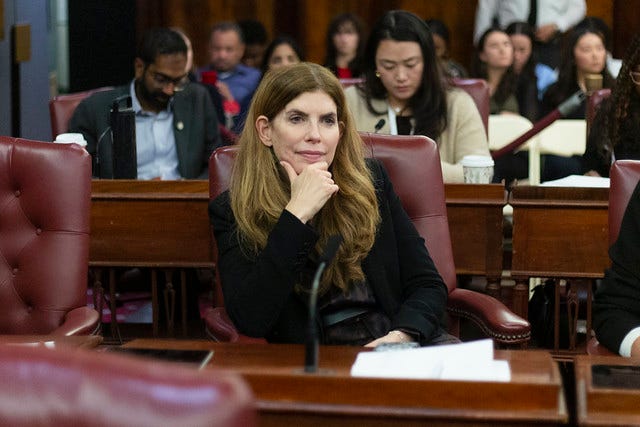
Credit: New York City Council/Flickr
The announcement last week that Julie Menin, a New York City Councilmember from the Upper East Side, had clinched the necessary votes to become Council Speaker caught some observers off guard. Part of that was the timing: Menin released her vote tally of 36 members — well above the required 26-member threshold — on the Wednesday before Thanksgiving. The race, which kicked into overdrive during the annual Somos conference in Puerto Rico, appeared to be narrowing down to two contenders: Menin and Crystal Hudson, a Brooklyn Councilmember who was seen as the more progressive option. And, as reporter Jeff Coltin pointed out, Menin declared victory the earliest of any Speaker candidate in history, dating back to Peter Vallone’s election as the first City Council Speaker in 1986. The timing was so unexpected that there was still a candidate forum scheduled for later this month.
A former small business owner and longtime public servant, Menin doesn’t fit into a neat ideological box. She has been widely described as a moderate Democrat, but her legislative record and the coalition she cobbled together—which includes major unions, some members of the Progressive Caucus, and Bronx and Queens county leadership—suggest a more complicated picture. And while much of the coverage of the Speaker’s race focused on areas of disagreement between Menin and the staunchly left mayor-elect, Zohran Mamdani, she struck a friendly tone in an interview with Politico New York today, vowing to work with Mamdani on shared priorities like making housing more affordable and delivering universal childcare.
The Speaker’s race—unlike a mayoral campaign—tends to be a marathon, not a sprint. The Speaker is directly elected by other members, rather than the public, making the incentives and tactics needed to mount a successful campaign very different than, say, Mamdani’s effort, which was powered by a large grassroots movement. Because much of the campaign plays out behind closed doors, some critics have darkly intoned about shady backroom deals and a lack of democratic input. But anyone who has been watching Menin’s career closely can see, with the benefit of hindsight, that she has been laying the groundwork for a successful run for years. She built a legislative record that won the support of major unions, cultivated close relationships across the ideological spectrum, and capitalized on a growing sense among some members in the body that the Council’s status as a coequal branch had been eroded. By the time she released the list of members supporting her, her elevation to the Speakership seemed less a surprise than a fait accompli.
Building Trust with Labor
To understand how Menin was able to line up the support of prominent unions, you have to go back in time a bit. In 2022, 32BJ, the union that mostly represents building workers, released a report finding that private hospitals were charging 3-4 times as much as public hospitals for certain procedures. The situation wasn’t just affecting consumers, the report argued — it was placing undue strain on the city’s budget, which was contending with an anemic post-COVID recovery and the beginning of a humanitarian crisis that saw thousands of migrants arriving by bus from border states like Texas and Arizona, many of them forced to sleep in the city’s already-overtaxed shelter system. The next year, Menin introduced legislation, in partnership with the union, to create an Office of Healthcare Accountability, which aimed to provide greater transparency on an opaque, patchwork hospital pricing system. The bill garnered vociferous opposition from industry groups like the Greater New York Hospital Association, but ended up passing the Council unanimously — no small feat in a a body with six Republican members.
A stiffer test came the following year, when Menin spearheaded the push for a bill to require every hotel in the city to obtain operating licenses from the city’s consumer protection agency and directly employ core staff, rather than using subcontracted labor. The legislation was supported by the Hotel Trades and Gaming Council (HTC) , a small union that has become a de facto kingmaker in city politics. The introduction of the bill sparked a huge battle, with many groups representing the industry predicting that the direct employment provision in particular would spell financial armageddon for many hotels. After much behind-the-scenes wrangling and an all-out media blitz by the bill’s opponents, the legislation was amended to address some of the industry’s concerns while retaining some of the worker protection provisions most important to HTC. It was signed by the Mayor in November.
This isn’t to argue that Menin chose these issues exclusively with an eye toward the Speakership, nor is it to say that her relationship with each of these unions began when she decided to take up these bills (she’s been in and around government for a long time). But in both cases, she demonstrated her chops as a thoughtful legislator and consensus-builder. Unions, fellow members, and other local power brokers took note. And sure enough, 32BJ and HTC were early and enthusiastic backers of her candidacy.
Collecting Chits
The Speaker’s race has been derided by some observers as a glorified popularity contest. There’s a kernel of truth to that, though the same can be said of any election: Being well-liked, and likable, tends to be an advantage, regardless of ideology. Zohran Mamdani’s campaign resonated because he zeroed in on an issue affecting many New Yorkers — the exorbitant cost of living — and offered a suite of concrete policies aimed at making the city more affordable. He’s also handsome, telegenic, and enjoys interacting with voters. There’s no denying that was a boon to his electoral fortunes, especially when juxtaposed with Andrew Cuomo, a man who approached retail politicking with all the enthusiasm of someone forced to assemble an IKEA bedframe without a manual.
Menin is, by all accounts, well-liked by her fellow members. She was also ubiquitous: showing up at community events, canvassing launches, and election watch parties in districts across the city. To use an oft-quoted Woody Allen line, 80% of success in life is showing up — and she showed up. Those gestures matter. So does the money: Menin donated more than $27,000 to incumbent members and new candidates through her campaign account, the most of any Speaker candidate. Hudson, by comparison, doled out about $12,000.
The amount any given candidate donates to their fellow members hasn’t historically been a determinative factor. But clearly those moves paid off for Menin—especially among the newly-elected members of the Council, some of whom faced very tough races. Six of the seven members of the freshman class, set to take office in January, ended up supporting her in the initial tally released last week.
Reasserting the Council’s Power
A new mayor will also be sworn in come January. Critics of Menin have seized on headlines painting her as an implacable adversary of the mayor-elect’s governing agenda. They point to reports that she has floated bringing back the Council’s little-used subpoena power, and that she has privately expressed skepticism about Mamdani’s proposed Department of Community Safety, which would divert mental health calls away from the NYPD and allow trained professionals to respond in certain circumstances.
Some context is needed here: the city government operates under a strong mayor system, meaning the City Charter (the municipal constitution) delegates broad powers to the mayor, like the ability to veto legislation and hire or fire agency heads. The Council plays a role in negotiating the annual budget, approving or disapproving land use projects, and conducting oversight on the administration. They also vote on some mayoral appointees.
Over the past four years, under Mayor Eric Adams and Speaker Adrienne Adams (no relation), the Mayor-Council relationship has deteriorated significantly. The relationship between the two former Bayside High School classmates is frosty. Administration officials have refused to testify at Council oversight hearings, once-cordial budget handshakes have devolved into bitter finger-pointing exercises, and the mayor has vetoed 14 bills during his term. Adams’ predecessor, Bill de Blasio, didn’t veto any bills in two terms.
Adams also convened two separate Charter Revision Commissions, which draft proposed amendments to the City Charter and allow New Yorkers to vote on them. Both were seen as ways to head off proposed Council measures, and stoked a lot of anger among members. In the most recent one, the Commission put forward several proposals to streamline the land use review process and curb the Council’s ability to vote down certain affordable projects. The Council, predictably, went to war against the proposals, blanketing the city with mailers urging voters to reject them. They ended up passing anyway.
Whatever you think about this dynamic (I voted for the ballot proposals), there is a widespread feeling among the Council that their power has been significantly eroded. When Menin (reportedly) talks about restoring the body’s ability to act as a check on the incoming administration, one could read that as the sales pitch of someone opposed to Mamdani’s program wholesale — and for some of the reasons discussed earlier, I don’t buy that. Or one can see it as a Council reasserting itself as a coequal branch of government. Asking tough questions about the structure, staffing, and funding of a new city agency like the Department of Community Safety, to take an example, could be a seen as a pretext for strangling the idea in its crib. Or it could be the Council fulfilling its Charter-mandated oversight role, just like it would with any other high-profile mayoral initiative.
Some will question why Mamdani chose to sit the Speaker’s race out, and not throw his weight behind Hudson, who appeared to be more ideologically aligned with him. Maybe his operation is more focused on the parts of his agenda that will require state funding, like free buses and universal childcare (although the City Council will have a role in each, since they’ll require city budgetary allocations). Maybe he wanted to avoid repeating the humiliation of his soon-to-be predecessor, whose handpicked candidate, Queens Councilmember Francisco Moya, was soundly rejected four years ago. Maybe he just wanted to avoid expending his political capital too early. Whatever the behind-the-scenes political calculus was, Menin will be his governing partner for the next four years. In the release announcing her victory, the incoming Speaker said her “coalition is ready to partner with the Mayor on its shared agenda to deliver a more affordable city for all New Yorkers.” The relationship she forges with him will determine whether they can fulfill that promise.