The Return
On Getting Back Into Tennis After a Long Hiatus

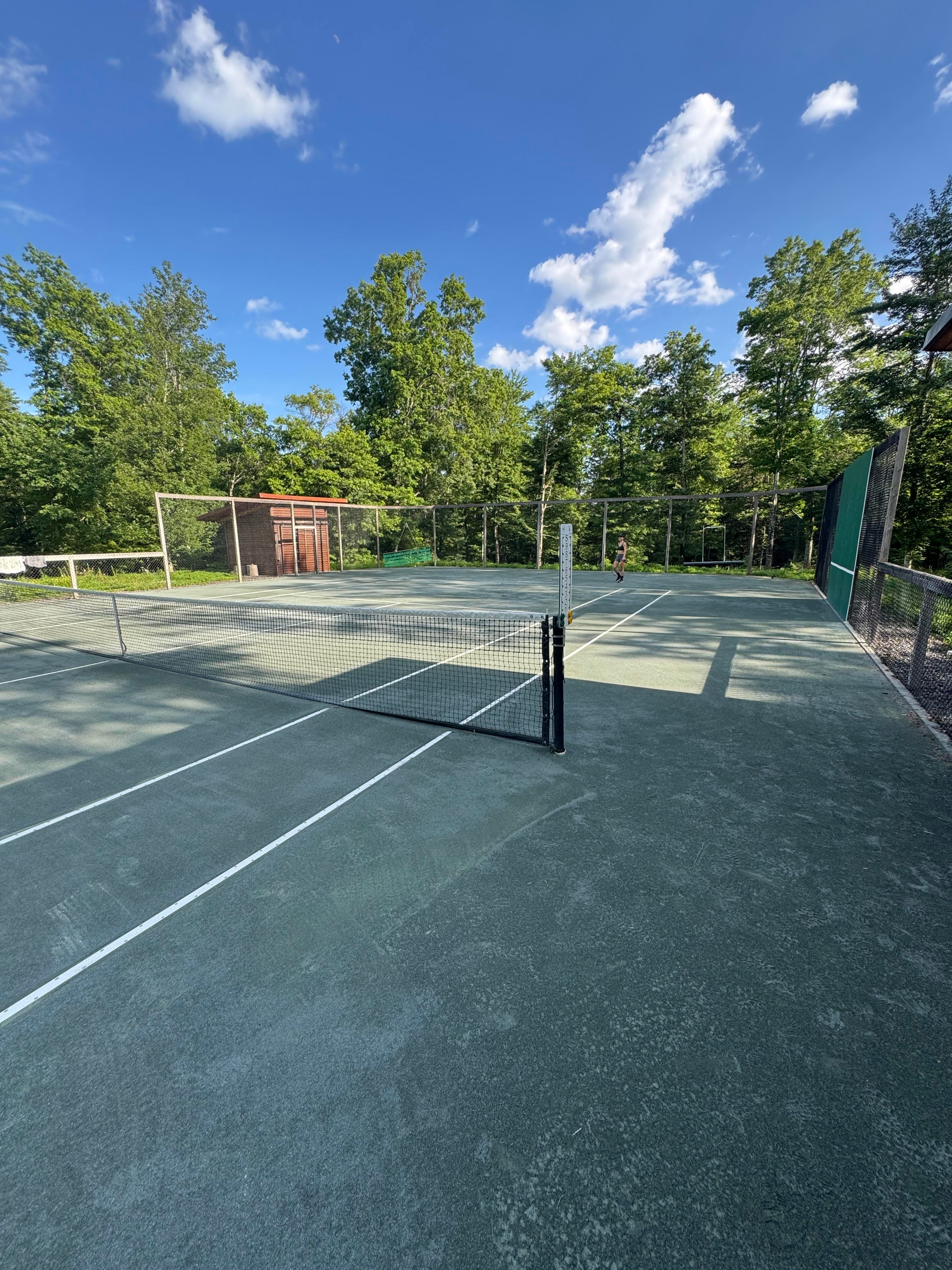
It’s the fate of many first loves to undergo a metamorphosis in memory — objects of wistful reminiscence, what-could-have-been flights of fancy. It’s not what or who they are so much as what they evoke: A period of life when you could feel things fully, heedlessly, undiluted by cynicism, the knowledge of what comes after. The well-integrated personality will see through the facade. With every love that follows, they adopt a sort of wabi-sabi approach: learn to appreciate the nick in the pot, the imperfections that accompany every beautiful thing, the rough edges a misplaced nostalgia tends to sand off. Those who try to return, to rekindle, eventually learn that the past can’t be recovered, despite our best efforts. The disillusionment, when it comes, will come too late.
That’s the conventional wisdom, at least. For me, the disillusionment actually came early. My first love was tennis. My mom, herself an avid player, introduced me at a young age. My attention never strayed far from the court after that. Tennis occupied my afterschool hours, my summers, my waking thoughts, sometimes my dreams. I went to clinics, signed up for tournaments, studied the pros, imbibed books about how to improve my mental game. I criss-crossed the city, exploring areas beyond the webbed reach of the subway system: Randalls Island, Forest Hills, Throggs Neck. By the time I made my high school team, it had developed into a full-blown obsession.
Trying to convey an enthusiasm that deep is difficult; something always gets lost in translation. But I loved it all: the faint petrol smell of a newly-opened can of balls. The slightly antiquated customs — the way every match, no matter how bitterly contested, concluded with a polite handshake at the net. The satisfying sound of contact with the racket’s sweet spot (the dead center of the strings). Mostly I loved the solitude. You might have your cheering section with you, offering you words of encouragement, but you’re essentially alone out there, contending with your own nagging doubts as much as you are the person across the net. It’s a good sport for brooding, which is probably why it attracts more than its fair share of writers.
Even as we finished the season my senior year, though, I was preparing to say goodbye. I’d already flirted with the idea of quitting. Earlier that year I auditioned for a school play, and while I wasn’t much of an actor, the male-female ratio in the theater community was better than it was on the men’s tennis team. Still, my impending retirement wasn’t entirely by choice. For all the time I’d dedicated over the years, on and off the court, I was a middling competitor. My win-loss record was abysmal. I crumbled in the big moments.
I got exactly one college offer, from Bard, a school I was shocked to learn 1. was interested and 2. had a tennis team (evidently one in desperate need of players: I hadn’t even submitted a tape). I ended up going somewhere else. The gym in my new school’s brochure-worthy fitness center overlooked the indoor courts, and I would watch the men’s team practice from time to time. It wasn’t just that the game looked different, from that vantage, than whatever I’d been playing. I hardly even recognized the physical specimens stalking around the courts — with their ropy muscle and lean, wolfish faces. They reminded me of those varieties of fauna Darwin observed in the Galapagos, their bodies evolved to do one thing really well. I’d pinch the flab forming at my midsection before returning to my workout.
It would be about a decade before I picked up a racket again. Tennis fell away; all the obligations of adulthood rushed in to take its place: starting a career, building a home with a partner, finding a community, making rent, learning what a deductible was. Life, especially at that age, seemed too crowded to accommodate such an all-consuming obsession, unless it was income-generating. I’d feel a pang every time I passed a court, but it was dull and removed, a bruise on a phantom limb.
A strange confluence of factors brought me back. My mom passed unexpectedly, I left my job shortly after, and I found myself, for the first time in my adult life, with a decent amount of time and money to burn. You generally need these ingredients—money, time, a car, or preferably, all three—to play with any regularity in New York City, unless you’re one of those freaks who can wake up at 6:00 AM, book a court, work a full day, and then play in the evening. I’m unemployed and not a masochist, so uh, no.
From my unscientific polling of fellow players, mine isn’t an uncommon story; I was just late to the party. The city’s tennis community seems to have ballooned during the pandemic, as people looked for outdoor activities that adhered to social distancing guidelines. A robust community of tennis influencers also sprang up, committed to spoiling every well-kept secret in the city (Brian Watkins, we hardly knew ye). Some of the players were newcomers, others, like me, were returning after a long hiatus from the sport. New York’s tennaissance has greatly expanded the pool of available hitting partners, but it’s also made it a nightmare to book a court in a city where court space is already finite. Which means a lot of my time these days is spent standing around and waiting, looking vaguely ridiculous as I do my warm-ups, test my strings, slip on my gear.
It’s especially hilarious to be getting back into competitive sports now, on the wrong side of 30, and in the throes of a benign-but-incurable condition. Call it Early Onset Unc-dom. My back hurts. My algorithm has begun serving me ads for finasteride. I have opinions on things I never cared about before: kids who skateboard in the subways, the music volume in cafes. When I get up from my favorite chair, I make an involuntary noise (imagine a show seal forced to come out of retirement). I have a “favorite chair.”
And the stakes truly could not be lower. When I was young, and harbored ambitions of playing in college, every match was freighted with pressure. Even after it became clear that dream wouldn’t pan out in quite the way I’d hoped, I still wanted to conclude my collegiate career on a high note. At this stage, that pressure is long gone. There’s nothing riding on this 8-game pro set with a UX designer who started playing a few years ago “to get out of the house,” save maybe bragging rights. So if there’s no real telos, why the solemnity, the sense of ritual that attends every match? Why am I scribbling little tennis-themed affirmations in my notebook to consult during changeovers (e.g. “Trust your backhand”)?
Part of it, I’ve realized, is a rejection of exactly that way of thinking: The joy I take in playing can exist independently of its outcome. It sounds trite, but competitive sports has a way of investing even the most hackneyed phrases with some deeper truth, like this one: I’m in it for the love of the game. The contours of life are more legible in the 78’ x 36’ dimensions of a regulation court. The emphasis on score, ranking, what poet Terrance Hayes calls (fittingly) “the racket of ascension” need not obtain. And the rest comes down to love — the real, more enduring kind: To encounter something familiar anew, find it utterly changed and still as perfect as you remembered it.
Nicely emoted Jonah. Thank you for teaching me the term wabi-sabi. 3 more points:
1) so that's why you started theater at Trinity huh. Sly dog. But you're not wrong
2) I heard the sound when you described the ball hitting the dead center of the strings and I loved it, the sound. What a thwack.
3) hilarious that Bard pleaded for you to join their tennis team. I went to Bard and don't recall ever seeing a "team" or court.
4) got your copy of DFW's anthology String Theory close at hand? Time to reread "Derivative Sport in Tornado Alley"?
Couldn’t have said it better myself on my Substack!!!